
Two-Dimensional Organic Semiconductor-incorporated Perovskite (OSiP)
University
Emory University
Presenter
Dr. Letian Dou
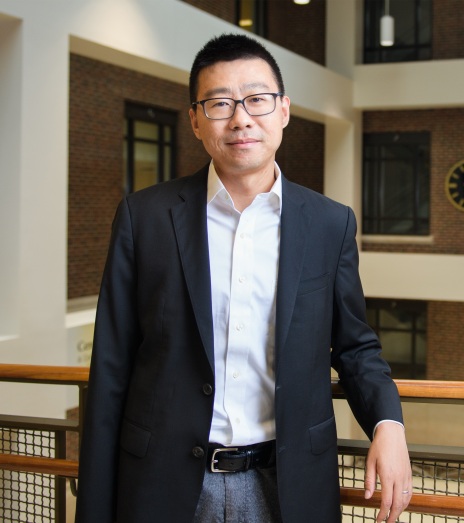
Bio: Dr. Letian Dou is currently the Paul & Phyllis Fireman Professor of Chemistry at Emory University. Prior to that, he was Charles Davidson Associate Professor of Chemical Engineering and Chemistry (by courtesy) at Purdue University. He obtained his B.S. in Chemistry from Peking University in 2009 and Ph.D in Materials Science and Engineering from UCLA in 2014. From 2014 to 2017, he was a postdoctoral fellow at University of California-Berkeley and Lawrence Berkeley National Laboratory. His research interest includes the design and synthesis of novel polymers, organic-inorganic hybrid materials and low-dimensional materials, fundamental understanding of the structure-property relationships, as well as applications in high performance electronic and optoelectronic devices. He is a recipient of Small Young Innovator Award (2025), ACS Photonics Young Investigator Lectureship award (2025), Humboldt Research Fellowship (2024), Waterloo Institute for Nanotechnology (WIN) Rising Star Award (2022), AIChE Owens Corning Early Career Award (2022), NSF CAREER Award (2021), Advanced Materials Rising Stars Award (2021), Office of Naval Research Young Investigator Award (2019), Highly Cited Researcher in Cross-Fields (2019-present), MIT Technology Review Innovators Under 35-China Award (2018), among others.
Abstract: Two-dimensional (2D) organic-inorganic hybrid perovskites have garnered considerable attention due to their rich chemistry and intriguing physical properties. Hybridizing organic functional group into the 2D lattice opens many exciting new opportunities. In this talk, I will provide a brief overview of our recent efforts in the development of 2D Organic Semiconductor-incorporated Perovskite (OSiP) materials. These include the molecular design and self-assembly of novel hybrid structures, precise control over crystal growth and nanoscale architectures, fabrication of both lateral and vertical heterostructures, and exploration of their unique optical, electronic, thermal, and ferroelectric properties. I will also discuss their promising applications in photovoltaic, light-emitting diode (LED), and laser devices.